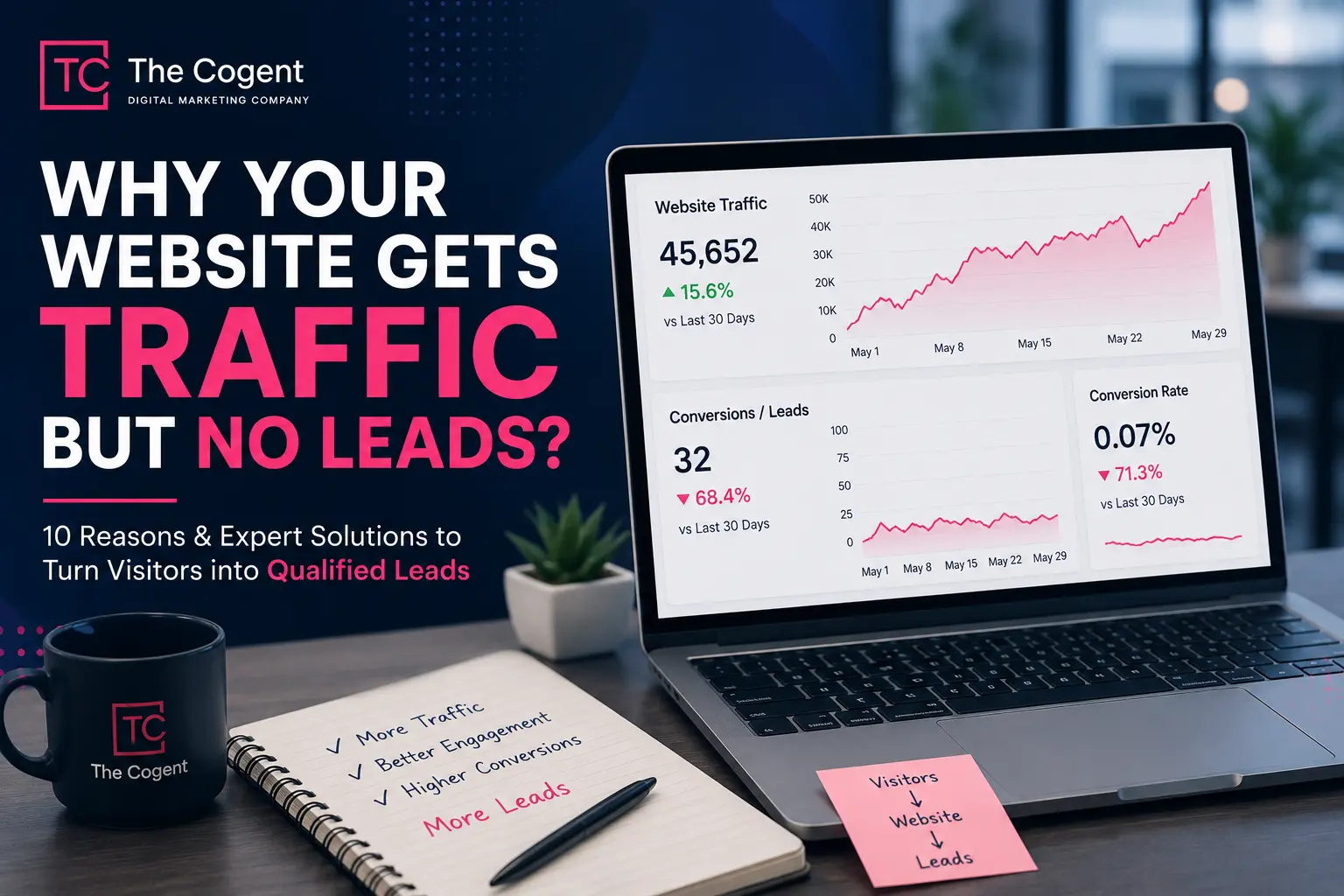
If you are wondering why your website gets traffic but no leads, the answer lies in the relevance of the product to the user’s search intent, not volume. Traffic reflects interest at the top of the funnel. At the same time, conversion reflects trust and intent.
To counter these challenges, the best digital marketing company in Jaipur curates SEO strategies that reach to the right visitor who is searching for a specific product or service. This guide explains how the traffic problem is being separated from a conversion problem, common causes and the fixes that turn interest into leads.
Why Website Traffic Doesn’t Always Mean More Leads?
Increased website traffic does not mean lead generation because of the mismatch between the searcher’s intent and your website’s ability to convert those visitors into leads. Here are some more factors that can help you understand why your website gets traffic but no leads:
Traffic Alone Doesn’t Generate Business
Visits from irrelevant searches boost clicks without increasing the pipeline. Business growth follows when the right people visit your sites, fill in their information or make a transaction, not when raw sessions climb.
The Difference Between Visitors and Qualified Leads
Website visitors are those people who just browse the websites, get the information and close the tabs. Whereas, quality leads are people who are interested in your services/products.
Why Conversion Rate Matters More Than Traffic
Conversion rate means the number of users who are ready to conduct some actions, such as completing the contact form or booking a consultation. This is why conversion rate optimisation matters more than chasing bigger numbers.
Understanding the Customer Journey
Customer journey means the process of moving from one phase of awareness to decision-making in relation to buying the product or service of your company.
Here is a brief overview of how leads affect different business results:
| Website Performance | Business Outcome |
| High Traffic + Low Leads | Poor Conversion Strategy |
| Low Traffic + High Leads | Strong Targeting |
| High Traffic + High Leads | Healthy Website |
| Low Traffic + Low Leads | Traffic & Conversion Issues |
How to Know If You Have a Traffic Problem or a Conversion Problem
Figuring out why a site has website traffic but no conversions requires evaluating multiple factors. The following five checks can help you better understand the reason behind poor leads.
Check Google Analytics
Open Google Analytics on your PC and head to Reports > Acquisition > Traffic acquisition. In this path, any failing or inconsistent traffic points usually suggest a traffic issue. However, where there is consistent traffic together with constant conversion points, there could be an issue with conversion.
Review Google Search Console
Open Google Search Console and go to Performance > Search results report. Enable the Queries section and order by Impressions. From here, look at the phrasing of the search queries. Informational queries like “how to” and “what is” indicate that people are researching. If people have intentions to buy, their queries include services, locations, or prices.
Measure Conversion Rate
The conversions indicate the effectiveness of your website to turn visitors into customers. If your website has 5,000 visitors and among them only 100 visitors have shown interest, it means your website conversion rate is 2%.
Identify High Exit Pages
An exit page is the last webpage your visitor views before leaving the website. A high exit page analysis helps you work on improving a specific section or site.
Track User Behaviour With Heatmaps
Website heatmaps are data visualisation tools that use colour-coded overlays to show how visitors interact with your pages.
You can also use the following checklist to determine whether your website has a traffic issue, a conversion issue, or both:
You likely have a traffic problem if:
- Your website attracts very few visitors each month.
- Organic search impressions and clicks are consistently low.
You likely have a conversion problem if:
- Visitors leave without filling out forms or making purchases.
- Heatmaps show users ignoring your primary call-to-action.
10 Reasons Your Website Gets Traffic But No Leads
A website can attract visitors while producing few or no enquiries. The ten reasons below set out why websites are not generating leads in practice:
1. You Are Attracting the Wrong Audience
When content and target keywords attract people who are gathering information instead of selecting a provider, visit numbers remain high while enquiries do not, because these visitors have little commercial intent.
2. Your Website Doesn’t Clearly Explain Your Value
When a homepage or service page does not state what the business does or who it serves, many visitors leave before an enquiry is placed.
3. Your Call-to-Action Isn’t Strong Enough
A ready visitor still needs a clear next step, and a hidden or vague button gives none. Every page should make the desired action obvious.
4. Visitors Don’t Trust Your Business
Most visitors do not like contacting a business that they can’t trust. Reviews, testimonials, case studies and identifiable client references provide the grounds for building trust, which is considered in the Turning Customer Reviews into Business Gold guide.
5. Your Website Is Slow
A slow page speed often reduces visitors’ interest in the site’s content. It also reduces the website’s credibility for making payments and browsing for information.
6. Your Website Performs Poorly on Mobile
Most visits now come from phones, so weak mobile responsiveness costs you a large share of that audience and the conversions it could bring.
You can see how this shapes rankings and conversions in the Core Web Vitals impact guide.
7. Landing Pages Don’t Match Search Intent
If a search result takes visitors to a page that does not correlate with the query, they will go away immediately. Pages that rank for a particular term but do not lead to the specific page also don’t count as qualified visits.
8. Contact Forms Create Friction
Every extra field you add to the form decreases submissions. Lead forms that ask for unnecessary information prevent potential visitors from completing them.
9. You Aren’t Tracking Conversions Properly
Without accurate conversion tracking, calls, forms and enquiries go uncounted, so you can’t tell which pages perform.
10. Your Website Doesn’t Guide Users Towards Action
Your website should lead your visitors through a certain path instead of letting them find their way. If your pages give them all the information and do not tell them what to do next, it may affect the visitor engagement.
Here is the summary of key problems:
| Problem | Impact | Recommended Fix |
| Wrong audience | Traffic with no buying intent | Target commercial-intent keywords |
| Unclear value | Visitors leave confused | State what you do and for whom |
| Weak call-to-action | Ready visitors stall | Use clear, visible action buttons |
| Low trust | Uncertainty blocks enquiries | Add reviews, testimonials and case studies |
How to Identify Where Visitors Drop Off?
To find the drop-off point, trace the visitor’s path stage by stage and see where most people leave. The five techniques below help diagnose a site with website visitors but no enquiries.
Landing Page Performance
As the landing page is the starting point, it is the first drop-off point to explore, as it is highly visited and yet keeps very few visitors. Weak website engagement here signals an early problem.
Funnel Analysis
The conversion funnel is a list of actions leading to an inquiry, service page, contact page and form filling. It allows detecting the particular stage when the highest number of visitors drops off.
Session Recordings
A session recording is an anonymised replay of one visit that captures the visitor’s clicks, scrolling and movement as they happened. Reviewing the recording of the visits that produced no enquiry reveals where visitors leave the site.
Scroll Depth Analysis
Scroll depth is how far down a page a visitor reads before stopping, usually shown as a percentage of the full page. In case most of the visitors leave a page without viewing the offer, scroll depth analysis shows that the placement of content is the reason for the drop-off.
CTA Click Tracking
Call-to-Action (CTA) click tracking shows how many times users click action buttons on the page, namely “Contact us” and “Request a quote”.
Each stage in the visitor’s path is best measured with a specific tool and the table below summarises what each one tracks and why it matters for locating drop-off:
| Tool | What does it measure? | Why Does It Matter? |
| Google Analytics | Sessions, engagement and per page | Shows which entry pages lose visitors first |
| Google Analytics | Movement between steps towards an enquiry | Reveals the step with the largest drop-off |
| Microsoft Clarity | Individual behaviour during a single visit | Explains why visitors leave, not only where |
| Microsoft Clarity | How far visitors scroll on a page | Explains why visitors leave |
| Event tracking (GA4 or Clarity) | Clicks on buttons and form fields | Identifies ignored or unused action prompts |
How to Turn Website Traffic Into Qualified Leads?
To turn your website traffic into qualified leads, guide visitors from visiting the front page of the website to enquire by giving them a clear reason to act at each step. The following methods to increase website conversions work through that process in order.
Improve Website Messaging
Website messaging is improved by stating three things clearly: what the business offers, who it is for and why it is the right choice. Learning how to create a digital marketing strategy can help you create a stronger website message.
Build Trust With Testimonials & Reviews
Testimonials and reviews build trust by showing that the business has delivered positive results for others.
Improve Website User Experience
User experience is the ease with which a visitor can read, navigate and act on a website. It has a direct effect on whether an interested visitor completes an enquiry. Partnering with a website designing company in Jaipur can help you build a better user experience that supports lead generation from the ground up.
Strengthen Calls-to-Action
The visitor should know exactly what to do and what they will receive in return. A precise one, such as “Request a free website audit,” gives a clear reason to the visitor to take the next step.
Improve Website Speed
Quick loading supports website performance and the conversions that depend on it. A page loading in one second converts roughly three times as high as a page loading in five seconds.
Create Better Landing Pages
A strong landing page is focused on a single offer. It matches the message of the advertisement or search result that brought the visitor.
Use Better Lead Magnets
A lead magnet is something of genuine value offered in return for a visitor’s contact details. Common examples of these lead generation strategies include a guide, a checklist, an audit or a template.
Align SEO With Business Goals
SEO is aligned with business goals by targeting the search terms that attract buyers and measuring success in enquiries. Within a wider digital marketing strategy, this means prioritising commercial search terms and matching each to a relevant page.
Website Traffic vs Qualified Traffic
Website traffic counts everyone who arrives, whatever their reason for visiting. The following distinction shows up clearly in the website conversion rate of website traffic and qualified traffic:
| Aspect | Website Traffic | Qualified Traffic |
| Who arrives | Any visitor, for any reason | People who match the ideal customer |
| Intent | Browsing or researching | Ready to buy or enquire |
| Engagement | Often leaves quickly | Explores services and offers |
| Enquiries | Rare relative to volume | Frequent relative to volume |
| Business value | Raises numbers, not revenue | Produces leads and sales |
Common Mistakes That Stop Websites From Generating Leads
Creating leads is not only about getting a website up or creating a handful of keywords. Without a good website that meets users’ needs or an effective marketing strategy, there is little hope for conversions. Avoiding the following common mistakes can improve both search visibility and lead generation.
- Poor Website Structure: You may experience lower conversions if your content does not serve the user’s intent.
- Ignoring User Intent: Creating content which does not match the search intent of people means lower conversions.
- No Digital Marketing Strategy: If your website lacks a clear direction for digital marketing campaigns, then its capacity for attracting quality traffic is limited.
- Ignoring SEO Performance: The importance of SEO consultant for small business lies in monitoring the rankings, organic traffic and conversions. It allows you to spot both opportunities and problems that might affect their SEO performance.
- Focusing Only on Rankings: Ranking on the first page of search results is important, but it shouldn’t be the end goal of your SEO efforts.
- Never Auditing the Website: Never auditing the website lets small problems accumulate unnoticed. Audits matter most after search updates, as covered in Google Algorithm Update Recovery.
Use this quick checklist to confirm none of these mistakes applies to your site:
- Success is measured by enquiries, not rankings alone
- Each page answers a clear search intent
- Navigation and structure are simple and logical
- Marketing efforts follow one coordinated plan
- Search performance is reviewed regularly
- The website is audited on a set schedule
Website Lead Generation Checklist
A high-performing lead generation website does a specific set of things well. The checklist below covers those essentials, so you can confirm each one is in place before expecting steady enquiries.
- Clear value proposition
- Fast website speed
- Mobile-friendly design
- Strong CTA
- Trust signals
- Reviews
- Contact forms
- Landing pages
- Conversion tracking
- Analytics
- SEO audit
- Technical SEO
- Core Web Vitals
- Internal linking
When Should You Hire a Digital Marketing Agency?
You should hire a digital marketing agency when your website’s growth has stalled and your leads are declining. They help you boost conversions with online reviews, improve website design and curate content that attracts visitors and turns them into valuable leads.
Signs Your Website Needs Professional Help
Your website is the first thing that customers see regarding your business. Here are some things that you need to know about when it’s time for professional help:
- High bounce rates
- Poor search rankings
- Slow loading speeds
- Low conversion rates
- Outdated design
Questions to Ask Before Hiring
Not every agency is the right fit, so ask the right questions before signing a contract:
- What is your experience in my industry?
- Which services are included?
- How do you report on progress?
- Who will be my main point of contact?
- What does your pricing structure look like?
For a deeper checklist, see our guide on how to choose the Best Digital Marketing Agency.
Benefits of Working With Professionals
Partnering with an experienced team gives you access to tools and strategies that are helpful to generating quality leads. Here are some more benefits of hiring a digital marketing company:
- Specialised skills in areas of SEO, paid advertising, content and social media.
- Tools for analytics, keyword research and automation.
- Scalability for increasing the scope of the marketing campaign to a wider audience as your company grows.
- More time to focus on running your business while experts handle marketing.
Why Website Design and SEO Must Work Together?
Website design and SEO must work together because design attracts visitors and SEO helps them find you first. Search engines reward sites that load fast, stay well-structured and work well on mobile. This overlap between usability and ranking is placed at the heart of how website user experience impacts SEO, where clean design and navigation lift both visibility and conversions.
Why Businesses That Focus on Conversions Grow Faster
Firms that consider conversions in their marketing strategies are well-placed in terms of turning their marketing activities into tangible outcomes. This can be seen in the following advantages.
- More Qualified Leads:
- Better ROI From Marketing
- Lower Customer Acquisition Cost
- Stronger Brand Trust
The difference between a traffic-first strategy and a conversion-first strategy becomes clear when you compare what each approach is designed to achieve.
| Traffic Focus | Conversion Focus |
| Measures website visits | Measures leads and customers. |
| Prioritises increasing traffic volume | Prioritises improving conversion rates. |
| Focuses on clicks and impressions | Focuses on enquiries, sales and revenue |
| Requires continuous traffic growth for better results | Generates better results from existing traffic |
| Success is based on visitor numbers | Success is based on business outcomes |
Conclusion
Understanding why your website gets traffic but no leads comes down to one distinction: attracting visitors and converting them are separate goals that must be measured separately. When messaging, speed, user experience, calls to action and search intent all align, an interested visitor can move smoothly from a click to an inquiry.
Where analytics show website traffic but no conversions, the priority is diagnosis, not more traffic. If your website shows the same high traffic but low leads, then it requires a professional website audit today.
FAQs
Your website may be attracting visitors who are not ready to buy, or it may have issues such as weak messaging, poor user experience, or ineffective calls to action that prevent conversions.
To make the conversion rate higher, one should take into account the users’ needs, optimise the loading time of the page, simplify the filling out of forms and earn people’s trust through testimonials and reviews.
The average conversion rate for many businesses is around 2-6%. However, high-quality websites have the metric exceeding that value due to continuous optimisation efforts.
Users leave the websites where they cannot find the needed information fast enough, have some UX problems and lack a strong reason to continue the interaction with the page.
Yes, the more time it takes to load a website, the higher the chances that people will leave and not convert.
Online reviews provide social proof. It enhances users’ trust and reduces their hesitation before getting in touch with the company.
Yes. If the process of SEO optimisation involves relevant keywords and proper navigation to landing pages, lead generation will increase.
To find out what is wrong with your website, use tools like Google Analytics 4, Google Search Console, Microsoft Clarity, heatmaps and session recordings.
Redesign your website when it is not user-friendly, slow loading speed, has low traffic and has a high bounce rate, even though the number of visitors is decent.
You need to hire a digital marketing agency when your website constantly fails to generate leads and when your marketing efforts stop bringing results.