Is SEO Dead in 2026? How AI Search Is Changing SEO, Not Replacing It

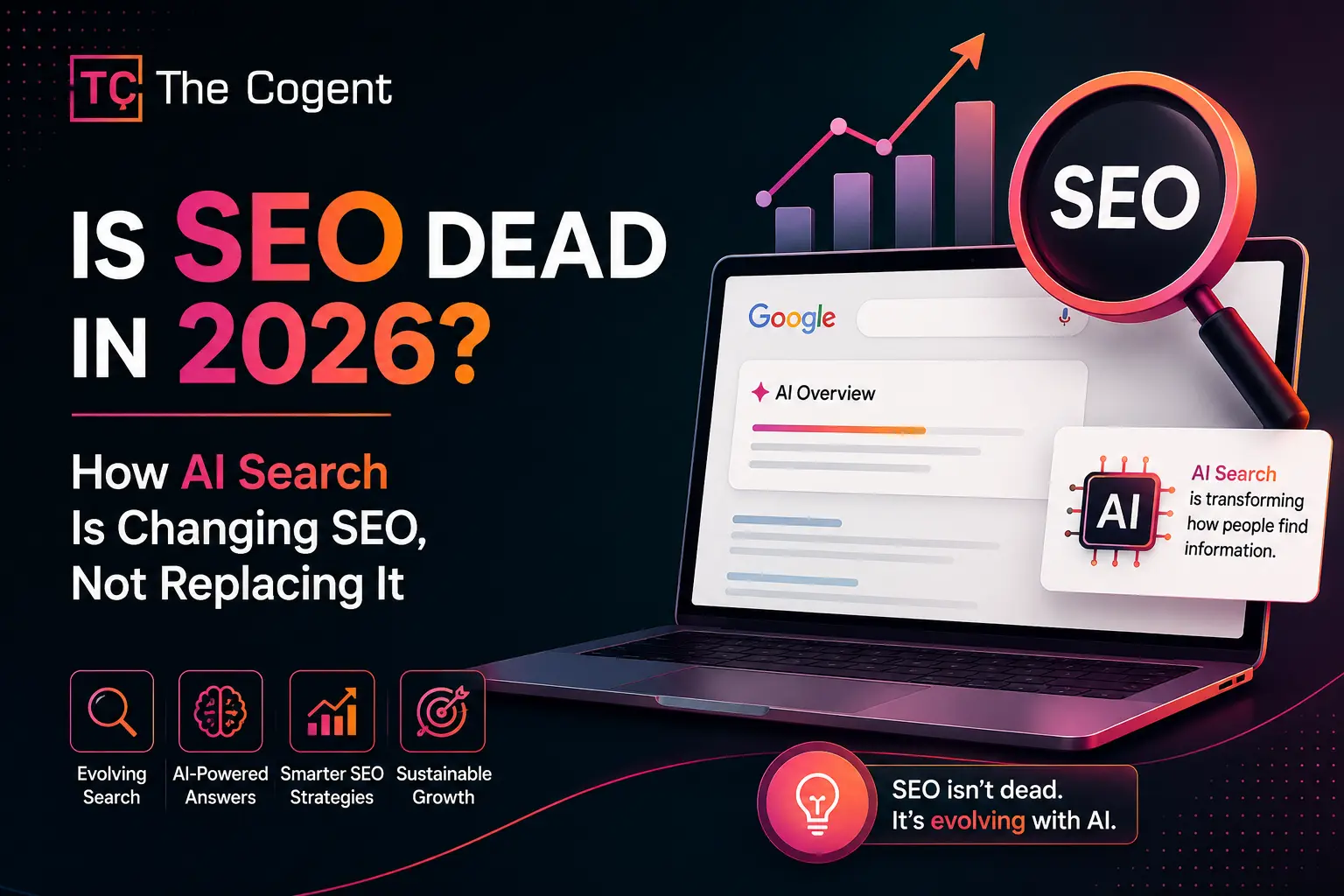
Is SEO dead in 2026, or has it just changed its way of functioning? The direct answer is no. SEO still works in 2026, though it looks nothing like it did five years ago. Recent SparkToro and Similarweb data show that 68.01% of US Google searches ended without a single click in the first four months of 2026, and yes, that number is alarming if you’re only looking at your traffic dashboard.
But zero clicks doesn’t mean zero value; it means the results have moved somewhere your analytics tool isn’t looking yet. Businesses working with the best digital marketing company in Jaipur are already adjusting for this, and it’s the ones who keep asking “is SEO dead?” instead of adapting who end up actually falling behind.
No, SEO Is Not Dead in 2026 – It Is Evolving Faster Than Ever
If we’re being precise about it, is SEO dead in 2026 is really the wrong question. The right one is whether your SEO strategy still matches how people (and AI) actually search now.
Spoiler: for most businesses, it doesn’t yet.
Before getting into what’s changed, it’s worth separating the fear from the facts, because a lot of the “SEO is dying” talk comes from watching one number (clicks) while ignoring three others that matter just as much (visibility, citations, and revenue).
Why Businesses Believe SEO Is Dead
Owners see their click-through rate drop and immediately assume the strategy failed. Ahrefs looked at over 800,000 keywords in December 2025 and found AI Overviews cut the average CTR for top-ranking pages by 58%. That’s a genuinely rough number to stare at, and it’s exactly why so many people panic first and investigate later.
What Has Actually Changed in Search
The results page itself now does more of the answering. Google’s AI Overviews, AI Mode, and a growing pile of rich SERP features often resolve a question before anyone clicks through to a website at all. This isn’t a Google-only story either. If you’ve followed how much a website structure affect Google rankings, the conversation now includes AI crawlers alongside Googlebot, and you already know how far this has spread.
Why AI Is Changing Search Behavior
People expect instant, synthesized answers now instead of ten links to sift through. That habit didn’t start with ChatGPT; it started years earlier with featured snippets, and generative AI just poured petrol on it.
Why SEO Still Drives Business Growth
Even in a mostly zero-click world, someone still has to write the content that AI ends up summarising and citing. Skip SEO entirely, and you don’t just disappear from clicks; you disappear from AI answers too, because AI tools are pulling from indexed, well-built websites, not thin air.
Old SEO vs Modern SEO
| Old SEO | Modern SEO |
| Keyword-focused | User-focused |
| Ranking pages | Solving user intent |
| Links only | Brand authority + Experience |
| Search Engine | Search + AI Platforms |
AI Is Changing SEO, Not Replacing It
AI is reshaping SEO by adding a whole new layer of visibility on top of rankings, not by making rankings pointless. Understanding how each AI system actually pulls its answers makes it a lot easier to write content that performs well across all of them, not just Google.
How Google AI Overviews Work
AI Overviews pull summarised answers from a blend of top-ranking pages and topically relevant ones. BrightEdge tracked this from February 2025 to February 2026 and found AI Overviews now trigger on roughly 48% of tracked queries, up 58% year over year, and they clearly favor pages with real depth and clean structure.
How Google AI Mode Changes Search
AI Mode goes further still, breaking one question into several smaller ones and researching each before stitching together a final answer. That rewards sites that cover a topic properly rather than scattering one thin page per keyword.
How ChatGPT, Gemini, Claude & Perplexity Find Information
These tools blend their own training with live web retrieval, and they consistently lean toward sources with strong domain trust, recent dates, and clean factual structure. Sites that have invested in innovative AI SEO strategies tend to show up across several of these platforms at once, not just one.
Why AI Still Depends on High-Quality Websites
Every AI answer engine needs a web of original, well-researched content behind it. Without publishers doing the actual work of research and writing, there’s nothing for AI to summarise in the first place. That’s the whole reason SEO still matters. AI didn’t remove the need for good content; it just added a middleman.
Why AI Search Rewards Trusted Brands
SE Ranking’s latest research found domain authority is the strongest single predictor of AI citation, with high-authority sites earning roughly three times more citations than weaker ones. Brand trust isn’t a nice-to-have anymore; it’s a ranking input.
| Google Search | AI Search |
| Blue links | AI-generated answers |
| Multiple results | Direct answers |
| Keyword relevance | Authority + Context + Entities |
| Rankings | Citations & Recommendations |
Curious where you actually stand? Request a professional website and SEO audit and see how visible your brand really is across Google and AI platforms.
Yes, SEO Still Works in 2026 Because Businesses Still Need Visibility
Yes, SEO still works in 2026 because whether it’s a blue link or an AI citation, visibility is still what connects a business to a buyer. The channel just split in two; the need behind it never went anywhere. Here’s what that ongoing value looks like once you get past the headlines.
-
SEO Still Generates Qualified Traffic
Organic search is still one of the highest-intent channels around because people are actively looking for a solution, not being interrupted mid-scroll. WordStream’s 2026 data found that 63% of businesses said AI Overviews actually had a positive effect on their organic traffic, visibility, or rankings since the rollout, which is a fairly big contradiction to the doom-and-gloom take.
-
SEO Builds Long-Term Brand Authority
Well-structured content compounds in a way paid ads simply don’t. Every piece you publish adds to your topical footprint, something a good website development company in Jaipur thinks about from the moment they’re building the site’s architecture, not as an afterthought.
-
SEO Supports Every Marketing Channel
Strong SEO content ends up fuelling your email campaigns, your social posts and even your sales calls. It’s rarely a standalone channel; it’s usually the research engine behind your whole create a digital marketing strategy plan.
-
SEO Helps AI Understand Your Business
Clear entity signals, structured data, and consistent business details across the web all help AI correctly figure out who you are and what you actually do. That directly affects how often you get recommended when someone asks an AI chatbot for a suggestion.
-
Why Organic Search Remains a Valuable Business Asset
Unlike ad spend, organic visibility doesn’t vanish the second you stop paying for it. It’s an asset that keeps working and, increasingly, keeps earning AI citations, long after you’ve published and moved on.
Some SEO Strategies No Longer Work in 2026
Some SEO habits genuinely don’t work anymore in 2026, and honestly, clinging to them is often the real reason a business ends up convinced SEO has failed, when it’s really just their approach that has. Here’s what used to move the needle and now quietly holds brands back instead.
-
Keyword Stuffing
Cramming the same phrase into every other sentence reads as spam to users and AI alike now. Both prioritize natural language and genuine coverage of a topic over how many times you repeat a keyword.
-
Thin AI-Generated Content
Mass-produced, generic content with nothing original in it rarely earns a citation anywhere. Pages that aren’t updated quarterly are three times more likely to lose AI citations, and thin content tends to age the fastest of all.
-
Buying Low-Quality Backlinks
Spammy, irrelevant links can get you penalized instead of boosted. If you’ve been hit by an update, that’s usually when businesses come looking for Google algorithm update recovery help, and link schemes are often the culprit.
-
Publishing Content Without Search Intent
Ranking for a keyword means nothing if the page doesn’t actually answer what the person typed it for. Mismatched intent is one of the fastest ways your website gets traffic but no leads.
-
Ignoring User Experience
A slow, cluttered, confusing site loses people and rankings. This is exactly why how website user experience impacts SEO has become a genuinely unavoidable part of any real strategy now.
-
Creating Pages Only for Rankings
Doorway pages and near-duplicate location pages built purely to game the algorithm offer almost nothing of value, and both Google and AI systems spot them pretty easily.
-
Chasing Rankings Instead of Business Results
Staying at position one for a keyword that never converts is a vanity win. Real SEO in 2026 measures leads, revenue, and AI visibility, not just where you appear on a SERP.
| Outdated Practice | Why It Fails | Better Alternative |
| Keyword stuffing | Reads as spam, kills trust | Natural, intent-led writing |
| Thin AI content | No depth, loses citations | Experience-based content |
| Low-quality backlinks | Risk of penalties | Genuine off-page SEO techniques |
| Content without intent | Traffic that never converts | Intent-mapped content plans |
| Poor user experience | Higher bounce, less trust | UX-first design |
These SEO Strategies Still Deliver Results in 2026
These are the SEO strategies still genuinely delivering in 2026, and most of them will look familiar because good SEO has always rewarded quality over shortcuts. That part hasn’t changed.
-
Create Helpful, Experience-Based Content
Writing from real, first-hand experience beats generic advice every time, especially now that AI models are getting noticeably better at spotting the difference.
-
Build Topical Authority
Covering a subject properly across several connected pages, instead of one lonely post, tells both search engines and AI systems you actually know the topic.
-
Strengthen E-E-A-T
Real experience, real expertise, real authority, real trust. Still the backbone of ranking well, and we’ll get into exactly what that means shortly.
-
Improve Technical SEO
None of the above matters if your site is slow or badly built. Fast load times and clean architecture decide whether your content gets found at all.
-
Focus on Search Intent
Matching what you write to what someone’s actually looking for still beats keyword-first writing, every single time.
-
Optimize for AI Search
Writing in clear, well-organized, quotable sections improves your odds of getting pulled straight into an AI Overview or a chatbot answer.
-
Build Brand Authority
A trusted, recognizable brand earns more citations and more clicks, which is exactly why the importance of SEO consultant for small business growth keeps coming up in client conversations.
-
Improve Website Experience
A smooth, mobile-friendly site keeps people around long enough to actually convert, not just bounce off the first page they land on.
-
Continuously Update Existing Content
Refreshing older pages with new data keeps them eligible for citations, since AI systems consistently favor recently updated, accurate sources over stale ones.
Quick Checklist: SEO Strategies That Still Work
- Publish experience-based, original content
- Build interconnected topic clusters
- Strengthen E-E-A-T signals sitewide
- Fix technical SEO issues regularly
- Match content to real search intent
- Structure pages for AI extractability
- Invest in consistent brand building
- Refresh key pages every quarter
Traditional SEO vs AI Search Optimization
Traditional SEO and AI search optimization aren’t rivals fighting for your budget; they’re two layers of the same visibility system, and most businesses need both running at once.
Knowing where they overlap and where they split makes it a lot easier to figure out where to actually spend your time.
-
Understanding the Difference
Traditional SEO chases rankings and clicks. AI search optimization, often called generative or answer engine optimization, chases something different: getting quoted, cited, or recommended inside an AI-generated answer.
Where Traditional SEO and AI SEO Overlap
Both still lean on quality content, technical health, backlinks, and topical authority. A site with solid traditional SEO already has a real head start toward AI visibility; it’s not starting from scratch.
Why Businesses Need Both Strategies
Ignore traditional SEO, and you lose a substantial number of searches, still sending clicks. Ignore AI optimization, and you miss citations across ChatGPT, Gemini, Claude, and Perplexity, where data puts AI-assisted search activity at around 56% of global search usage combined.
| Traditional SEO | AI Search Optimization |
| Rankings | Citations |
| Keywords | Entities |
| Backlinks | Brand Authority |
| Search Results | AI Answers |
| Clicks | Visibility Across Search Platforms |
How to Optimize Your Website for Google AI Overviews, ChatGPT & AI Search
You optimize for Google AI overviews, ChatGPT, and the rest by structuring your content around clear answers, credible sourcing, and consistent brand signals. None of this is complicated; it’s just easy to skip.
Here’s the practical list most businesses haven’t gotten to yet.
-
Write Experience-Based Content
Share real examples, real numbers, real case studies wherever you can, instead of the same generic advice that’s already living on fifty other websites.
-
Answer Questions Clearly
Open each section with the actual answer before you get into the details. It’s exactly the structure AI tools prefer to lift and summarise.
-
Improve Entity Recognition
Keep your business name, services, and location consistent everywhere – your website, your directories, your social profiles, so AI can confidently work out who you actually are.
-
Build Trust Signals
Author bios, credentials, testimonials, honest business details, all of it strengthens how trustworthy your content looks to readers and AI crawlers alike.
-
Add Structured Data
Schema markup helps both search engines and AI tools understand the context of what you’ve written, which improves your odds of landing in rich results and AI Overviews.
-
Improve Website Speed
A sluggish site frustrates people and can limit how well AI crawlers index your pages in the first place. The core web vitals impact on rankings and AI visibility is genuinely well-documented at this point.
-
Earn High-Quality Mentions & Backlinks
Getting mentioned on reputable, relevant sites builds exactly the kind of authority AI systems weigh heavily when choosing what to cite.
-
Keep Content Updated
Old statistics and stale examples quietly hurt your citation chances, so a regular refresh schedule matters more now than it ever did.
-
Build a Recognizable Brand
Seer Interactive’s 2026 data found that brands cited inside AI Overviews earn roughly 120% more organic clicks per impression than uncited competitors on the exact same queries. Brand recognition isn’t fluffy marketing talk anymore; it’s a measurable performance lever.
AI Search Optimization Checklist
- Structure content with clear, direct answers
- Keep NAP and entity details consistent everywhere
- Add schema and structured data sitewide
- Prioritize page speed and mobile performance
- Earn backlinks from credible, relevant sources
- Refresh statistics and examples regularly
- Build visible author expertise and bios
Is Your Business Losing Traffic Because of AI Overviews?
Your business might well be seeing fewer clicks because of AI Overviews, but that doesn’t automatically mean you’re losing revenue, and that difference matters more than most dashboards let on. Getting zero-click search right in your head changes how you should be measuring success.
-
Understanding Zero-Click Searches
A zero-click search resolves right there on the results page: an AI Overview, a featured snippet, a knowledge panel, anything.
-
Why Lower Clicks Don’t Always Mean Lower Revenue
Someone who clicks after reading an AI summary usually arrives already informed and closer to a decision. Several industry studies link that kind of visitor to noticeably stronger conversion rates than average organic traffic.
-
How to Measure SEO Success Beyond Rankings
Start tracking brand mentions, AI citation frequency, and lead quality alongside your usual rank and traffic numbers. Rankings alone tell an incomplete story in 2026; they always did, really; it’s just more obvious now.
-
Why Brand Visibility Matters More Than Ever
Even an AI citation that nobody clicks still puts your brand in front of a genuinely high-intent audience. It functions a lot like a very well-targeted, very well-trusted placement.
| Traditional SEO Metrics | Modern SEO Metrics |
| Rankings | AI Citations |
| Clicks | Brand Mentions |
| Traffic | Qualified Leads |
| Impressions | AI Visibility |
| Sessions | Business Conversions |
E-E-A-T Is the Biggest SEO Ranking Factor in 2026
E-E-A-T is still the single biggest ranking factor in 2026, and if anything, AI search has made it matter more, not less, because an AI model has to trust a source before it’s willing to cite it.
Here’s what each piece actually looks like once you get past the acronym.
Experience
First-hand knowledge, real case studies, genuine examples, all of it shows your content comes from actually doing the thing, not just summarising what someone else wrote.
Expertise
Author credentials and real depth of knowledge on the subject build credibility with readers and algorithms both.
Authoritativeness
Getting referenced by other credible sources and consistently covering your subject in depth is what earns you a reputation as an authority rather than just another voice.
Trustworthiness
Clear policies, a secure site, accurate information and honest reviews all tell users and AI systems alike that they can actually rely on what you’ve published.
Why AI Platforms Prefer Trusted Brands
AI systems are built specifically to avoid citing unreliable sources. Weak E-E-A-T signals can quietly shut you out of AI visibility altogether, no matter how well you’re ranking traditionally.
| E-E-A-T Element | Business Example |
| Experience | Case studies from real client projects |
| Expertise | Author bios with relevant credentials |
| Authoritativeness | Mentions from respected industry publications |
| Trustworthiness | Verified reviews and transparent business details |
Reviews specifically deserve a mention here too, since they fall right at the intersection of trust and conversion. If you haven’t looked at how you boost conversions with online reviews, that’s usually one of the quickest wins available.
SEO Checklist for 2026
The future of SEO in 2026 really comes down to a small set of fundamentals done consistently, not dozens of scattered tactics chased half-heartedly for a month and abandoned.
Complete SEO Checklist for 2026
- User Intent Research
- Helpful Content
- Original Experience
- Technical SEO
- Core Web Vitals
- Mobile Optimization
- Schema Markup
- Internal Linking
- Brand Authority
- Quality Backlinks
- Topical Authority
- Entity Optimization
- AI Search Optimization
- Content Refresh
- Performance Tracking
- Website Audit
Voice search deserves a spot on this list, too, even if it’s easy to overlook. As more people ask questions out loud instead of typing them, voice search optimization is quietly becoming part of the same conversational-content push that AI Overviews already reward.
When Should You Hire an SEO or Digital Marketing Agency?
You should bring in an SEO or digital marketing agency the moment your in-house efforts stop keeping pace with how fast search itself is moving. For most businesses, that moment arrives sooner than they’d like to admit.
Here’s how to know it’s time, and what to actually ask before signing anything.
-
Signs Your SEO Strategy Is Falling Behind
Rankings dropping after an update, traffic staying flat despite regular publishing, or simply having no idea whether you’re showing up in AI citations, these are all signs it’s time for outside help.
-
Questions to Ask Before Hiring an Agency
Ask how they measure success beyond rankings, how they handle AI search optimization, and what their actual process looks like. It’s a fair way to choose the best digital marketing agency for your specific industry rather than picking whoever pitches the loudest.
-
Why SEO and AI Search Require Continuous Optimization
Algorithms and AI models update constantly, so a one-off SEO project rarely holds up for long without someone actively managing it afterward.
-
Benefits of Working With an Experienced Team
An experienced team brings tested frameworks, cross-industry insight, and dedicated tracking that most in-house setups just don’t have room for. The benefits of hiring a digital marketing company tend to compound the longer the relationship runs.
Why Businesses Need a Complete Digital Growth Strategy
SEO works best as part of a bigger picture that includes your website experience, your content, and your reputation, exactly the kind of complete approach the best digital marketing company in Jaipur builds around every client from day one. And if you’re specifically weighing local expertise, it’s worth comparing a few SEO companies in Jaipur before deciding who actually gets your market.
Why Businesses That Adapt to AI Search Will Grow Faster
Businesses adapting to AI search right now are going to outgrow the ones still treating 2020-era SEO as the finish line. That gap is only going to widen from here.
-
Better Organic Visibility
Consistent, well-structured, up-to-date content earns visibility in traditional rankings and AI answers at the same time, not one or the other.
-
More Qualified Leads
Better intent matching, backed by a genuine AI-first SEO strategy, brings in visitors who are actually ready to buy, not just browsing.
-
Stronger Brand Authority
Regular citations and mentions build recognition that compounds over time, much the way backlinks always used to.
-
Higher Conversion Opportunities
Trust built through E-E-A-T and steady visibility turns directly into more inquiries and more sales; it’s not an abstract benefit.
-
Sustainable Long-Term Growth
Unlike paid campaigns that stop the second the budget does, strong SEO and AI visibility keep working quietly month after month.
| Businesses Ignoring AI SEO | Businesses Adapting to AI SEO |
| Declining Visibility | Consistent Search Presence |
| Fewer Qualified Leads | Higher Quality Leads |
| Weak Brand Authority | Trusted Brand Recognition |
| Reactive SEO | Future-Ready Strategy |
| Lower ROI | Sustainable Business Growth |
It’s also worth thinking past the current SERP altogether. The future of SEO beyond traditional SERPs points toward a search landscape where visibility spans dozens of platforms, not just one homepage, and the businesses planning for that now will be the ones still standing out later. If you want a head start, the above-mentioned secrets to rank better on AI platforms can be helpful.
Conclusion
So, is SEO dead in 2026? No, not even close. Clicks are genuinely harder to earn than they used to be, but SEO still works for businesses willing to build real authority, structure their content for humans and AI both, and treat AI search optimization as an extension of good SEO rather than something separate. The brands winning right now show up consistently across Google Search, AI Mode, ChatGPT, Gemini, Claude, and Perplexity, not just on one results page. If you’re not sure where you currently stand, request a professional website and SEO audit and find out exactly where your visibility gaps are before your competitors close them first.
Frequently Asked Questions
It’s changed a lot, sure, clicks are harder to earn than they used to be, but the businesses doing SEO properly are still winning both the traditional rankings and the new AI citations game.
Sometimes, yes, click-through rates on certain searches have dropped. But a lot of that lost traffic shows up elsewhere, as brand visibility and citations that don’t always show up in a traffic report.
The big shift is AI Overviews and AI Mode becoming a normal part of search, not a novelty. That means writing content that gives clear, direct answers, not just content built to rank for a keyword.
Yes. It’ll keep changing shape; it always has, but the core idea of earning visibility through good content and technical health isn’t going anywhere.
No, and honestly, it’s the opposite. AI tools need good websites to pull answers from, so SEO is what makes you eligible to be cited in the first place.
No. Things like E-E-A-T and topical depth matter more now, not less, because AI models are pickier about who they trust.
Sometimes, yes, click-through rates on certain searches have dropped. But a lot of that lost traffic shows up elsewhere, as brand visibility and citations that don’t always show up in a traffic report.
They can pull clicks away from your top-ranking pages, but they also open a new door: getting cited inside the Overview itself, which puts your brand in front of people even without a click.
Genuinely helpful content written from real experience, solid technical SEO, topical depth, and strong E-E-A-T. None of this is new; it’s just non-negotiable now.
Keyword stuffing, churning out thin AI-written pages, buying cheap backlinks, and building pages purely to rank rather than to help someone. All of it does more harm than good at this point.
Write in a way that answers questions clearly and directly, keep your business details consistent everywhere online, add structured data, and don’t let your content go stale.
It’s the practice of shaping your content so AI platforms like Google AI Overviews, ChatGPT, and Perplexity actually pick it up and cite it in their answers.
Traditional SEO is about ranking and getting clicked. AI SEO is about getting quoted or recommended inside an AI-generated answer. They share the same foundation; they just aim at different outcomes.
It builds the kind of trust that both search engines and AI models look for before they’ll rank or cite you. Weak E-E-A-T quietly locks you out of both.
As soon as you notice your traffic plateauing, your rankings slipping after an update, or you genuinely have no idea whether AI platforms even know you exist. That’s usually the sign.