Table of Contents
- 1.Can ChatGPT Help Rank a Website? If Yes, Then How?
- 2.Understand How SEO Has Changed in 2026
- 3.Use ChatGPT for Search Intent and Keyword Research
- 4.Build EEAT-Driven Content with ChatGPT
- 5.Create AI-Friendly Content Structure
- 6.Optimize Content for Google AI Overviews
- 7.Use ChatGPT Beyond AI Content Writing
- 8.Common Mistakes That Prevent Rankings
- 9.A Practical Workflow to Rank a Website Using ChatGPT
- 10.Conclusion
Search has changed shape from what it was some years ago. Google AI Overviews now affect close to 48% of all tracked queries, and that number keeps climbing. Add ChatGPT Search, Perplexity AI, Gemini, and Copilot into that, and you get a search landscape that no longer resembles 2020.
Ranking on page one is still the goal. But the road there now runs through AEO (answer engine optimization) and GEO (generative engine optimization), not just classic SEO.
ChatGPT cannot rank a website. The honest truth is no AI tool can. What it can do is speed up research, sharpen your AI keyword strategy, tighten your structure, and help you build the kind of content that both Google’s algorithm and AI systems trust. Used well, it becomes a genuine part of your SEO workflow. Used carelessly, it produces thin, generic pages that can’t bring results.
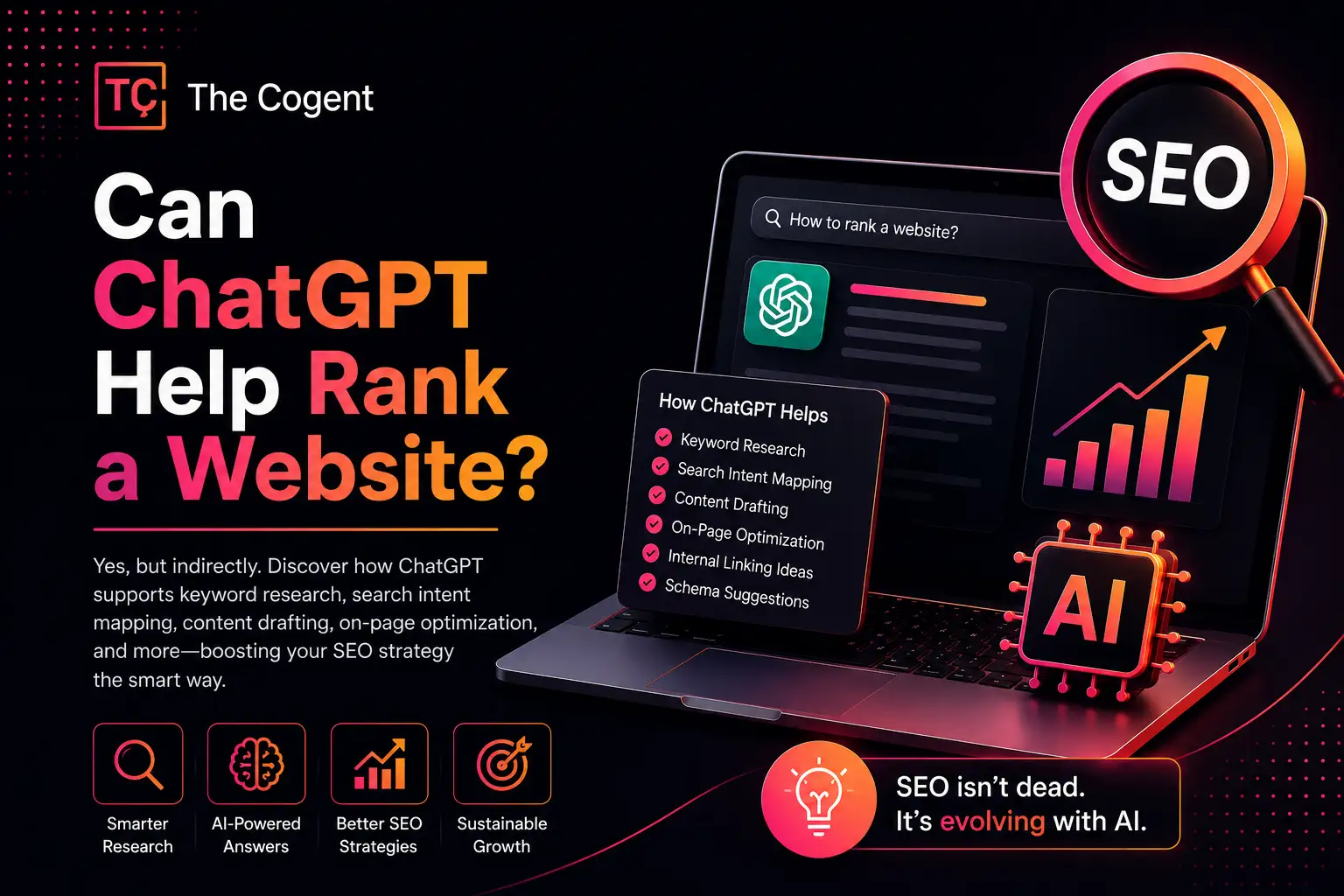
Can ChatGPT Help Rank a Website? If Yes, Then How?
Yes, but indirectly. ChatGPT helps with:
- Keyword research
- Search intent mapping
- Topical authority planning
- Content drafting
- On-page optimization
- Internal linking ideas, and
- Schema suggestions
It does not replace the fundamentals. Rankings still come down to content quality, EEAT, backlinks, user experience, and technical SEO.
- While answering ‘How to rank a website using ChatGPT?’ think of the tool as a fast, capable assistant sitting next to an experienced SEO strategist, not a replacement for one.
Understand How SEO Has Changed in 2026
Ranking used to mean one thing: beat ten blue links to position one. That’s no longer the whole picture. Zero-click behavior is now standard, with roughly 58% of Google searches ending without any click at all. Your content now competes for a spot inside an AI summary just as much as it competes for a blue link.
Traditional SEO vs AI Search
Classic Google Search rewards backlinks, on-page signals, and crawlability. Google AI Overviews, ChatGPT Search, Perplexity, and Gemini work differently. They pull from multiple sources and synthesize an answer. They cite only the pages that explain a topic clearly and completely. A page can rank on page one and still get skipped by an AI Overview if it doesn’t answer the question directly.
What AI Search Prioritizes
AI systems look for helpful content, real expertise, strong context, and clear entity relationships between topics. User satisfaction signals matter more than keyword density ever did. This is exactly why publishing AI-written articles with no editing, no fact-checking, and no original insight doesn’t work anymore. These systems are trained to spot shallow content and pass over it in favor of pages that actually teach something.
Use ChatGPT for Search Intent and Keyword Research
Keyword research used to stop at search volume. That’s outdated thinking now. Search engines and AI models both weigh intent heavily, so the smarter move is treating ChatGPT as a research partner that helps map what searchers actually want, not just what they type.
Find User Intent
Every query falls into one of four buckets: informational, commercial, transactional, or navigational. ChatGPT for SEO can quickly sort a keyword list into these categories, which tells you whether a page should educate, compare, sell, or simply guide someone to a destination.
Generate Keyword Clusters
Stop chasing single keywords. Build clusters instead, with a parent topic, supporting subtopics, and long-tail variations underneath. This mirrors how AI search engine optimization actually works, since these systems reward pages that cover a subject from multiple angles rather than one narrow phrase.
Build Topical Maps
Topical authority beats isolated articles almost every time now. A site with fifteen connected articles on a subject tends to outrank a single, longer piece written in isolation, because it signals depth and ongoing expertise on that entity.
Build EEAT-Driven Content with ChatGPT
EEAT (experience, expertise, authoritativeness, trust) is the backbone of ranking well in 2026, and it’s also the area where AI-assisted content most often falls short if nobody steps in to add a human layer. This is the section worth spending the most time on, because it directly separates content that ranks from content that gets ignored.
Add Experience
Real experience can’t be faked by a model. Bring in case studies, personal observations, original screenshots, and first-hand insights from your own work. ChatGPT can help you phrase these clearly, but the raw material has to come from you.
Demonstrate Expertise
Use accurate industry terminology, correct explanations, and credible statistics. Sites cited within AI Overviews earn about 35% more organic clicks and 91% more paid clicks than uncited competitors.
Establish Authority
Author bios, brand mentions, expert quotes, and thoughtful internal linking all send authority signals. These small additions tell both readers and algorithms that a real person stands behind the page.
Build Trust
Trust comes from updated facts, accurate data, transparency about sources, proper citations, and a human editing pass before publishing. Skipping the human review step is one of the fastest ways to undercut everything else you’ve built.
Create AI-Friendly Content Structure
Structure decides whether an AI system can actually parse and reuse your content. ChatGPT is genuinely useful here, since it can generate semantic SEO outlines, logical heading hierarchies, FAQ sections, comparison tables, and clear lists in seconds.
Below is a quick look at how structural elements map to what each platform tends to reward.
| Structure Element | Helps Google Search | Helps AI Overviews / ChatGPT |
| Clear H2/H3 hierarchy | Yes | Yes |
| FAQ sections | Yes | Strongly |
| Comparison tables | Moderate | Strongly |
| Bulleted lists | Yes | Strongly |
| Defined terms | Moderate | Strongly |
Structured information is easier for readers to scan and easier for AI models to lift into a summary. That dual benefit is exactly why structure matters more now than it did five years ago.
Optimize Content for Google AI Overviews
Getting cited inside an AI Overview requires a slightly different approach than ranking for a classic blue link. Healthcare content alone triggers AI Overviews on about 88% of related queries, so entire industries are already being shaped by this shift.
- Answer the core question directly in the opening lines. Keep paragraphs short and concentrated.
- Define important concepts plainly, back claims with supporting evidence, and use descriptive, question-style headings.
- Cover related questions on the same page instead of splitting them across separate posts.
Google tends to cite pages that comprehensively answer a cluster of related queries, not pages built around a single narrow keyword.
Use ChatGPT Beyond AI Content Writing
Content drafting gets most of the attention, but ChatGPT’s real value stretches further into the technical and editorial side of AI-powered SEO, where small fixes often move the needle faster than new articles do.
- On the technical side, it can draft meta titles, meta descriptions, schema markup ideas, image alt text, and canonical tag suggestions.
- On the AI content optimization side, it can flag internal linking opportunities, suggest content refreshes, and tighten readability and semantic keyword placement.
- On the editorial side, it can build content briefs, spot outdated articles that need updating, summarize competitor content, and generate FAQ ideas straight from real search queries.
Common Mistakes That Prevent Rankings
Most ranking failures trace back to a short list of repeated mistakes, and this list holds up whether the content was written by a person, an AI tool, or some combination of both.
- Publishing AI content without editing tops that list. Right behind it: ignoring search intent, keyword stuffing, thin content, and no topical authority around the main subject.
- Poor internal linking, outdated information, missing EEAT SEO signals, skipped human review, and a total absence of original insight round out the pattern.
- Organic click-through rate already drops by 61% on queries where an AI Overview appears, so there’s less room than ever to waste a page on avoidable mistakes.
A Practical Workflow to Rank a Website Using ChatGPT
Here’s a workflow that ties everything above into one repeatable process:
- Identify a topic worth targeting
- Research keywords and group them into clusters
- Understand search intent for each cluster
- Build a topical map around the main subject
- Create a detailed content brief
- Draft the article with ChatGPT as a starting point
- Add expert insights and first-hand experience
- Optimize for EEAT throughout
- Add relevant schema markup
- Publish
- Monitor rankings and AI citations
- Refresh the content regularly
Conclusion
ChatGPT is an assistant, not a shortcut around SEO expertise; this is the brief answer to ‘How to rank a website using ChatGPT?’ It’ll save you hours on research, drafting, and structuring a page. But whether that page ranks, and whether an AI Overview cites it, comes down to human judgment, trustworthy information, and content built for real readers. If you need expert guidance, partnering with a digital marketing agency in Jaipur can help turn AI-assisted content into a sustainable SEO strategy backed by experience and measurable results.
Build real authority, answer what people actually search for, and keep improving what’s published instead of chasing shortcuts. Do that, and you’re set up to win in a search world that’s gone AI-first.
Frequently Asked Questions
Mainly by saving time. It’s quick at keyword research, content briefs, drafts, and on-page cleanup. It won’t build your backlinks or fix technical issues on its own, though.
It can get you a decent first draft. But it still needs a human editing pass and some real expertise layered in.
Not directly. Google isn’t scanning for “written by AI.” What gets penalized is thin, unhelpful content, whether a person wrote it or not.
Get to the point fast. Answer the question right away, keep paragraphs tight, explain key terms clearly, and back claims with real evidence. Tackling related questions on the same page helps too.
Short for generative engine optimization: shaping content so tools like ChatGPT and Gemini can read it, make sense of it, and cite it correctly.
Three different targets. SEO chases traditional rankings. AEO aims at featured snippets and direct-answer boxes. GEO is about getting cited inside an AI-generated response.
Yes. Feed it a rough list, and it’ll sort keywords by intent, cluster them around shared topics, and pull out long-tail variations you might’ve missed.
It can point you toward meta tags, schema ideas, and alt text. Actually implementing that, or running a proper audit, still needs someone who knows the technical side.